sales@menred.com Deutsch Deutsch 中文 中文
MENRED S5 Energy Recovery Ventilator

MENRED S5 Energy Recovery Ventilator MENRED S5 Energy Recovery Ventilator MENRED S5 Energy Recovery Ventilator

MENRED S5 Energy Recovery Ventilator
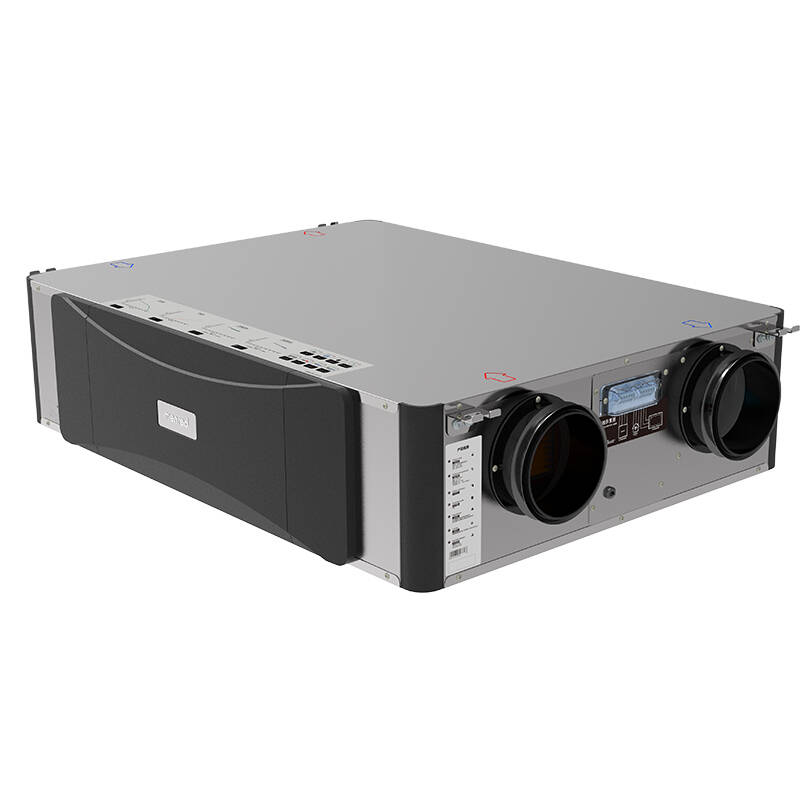
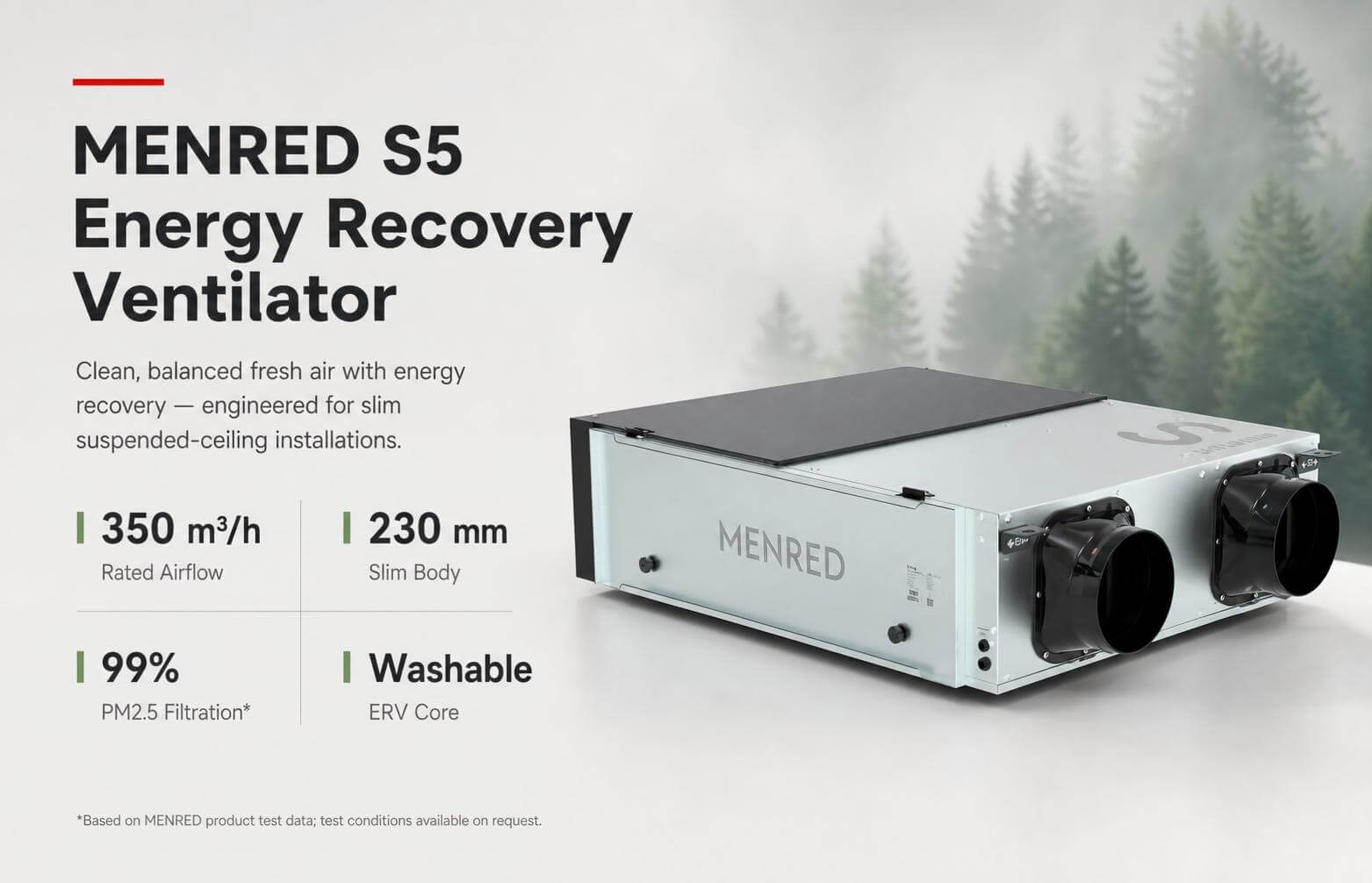
The MENRED S5 is built around one idea: the two air streams inside it never mix. Its core uses a non-porous membrane. Stale air leaves. Fresh air arrives. Heat and moisture cross the membrane, but the air itself does not. Add 99% PM2.5 filtration and you get 350 m³/h of clean outdoor air, room by room, all day.

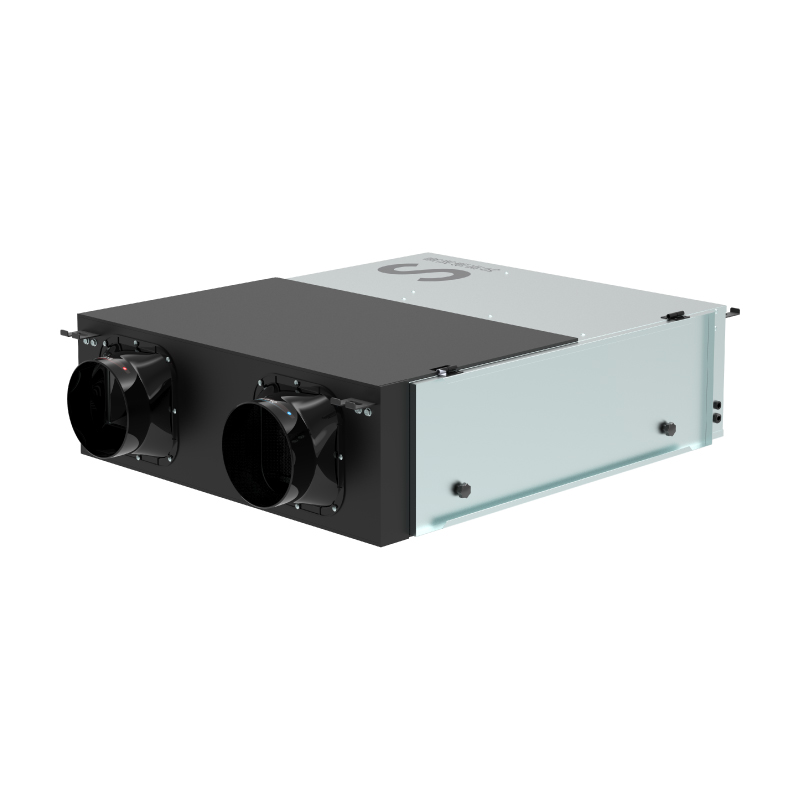
The S5 sits flat inside a suspended ceiling and connects to ducted supply and return layouts. It suits apartments, villas, clinics, and small offices. It also drops into MENRED WUHENG Climate System projects, where it works next to radiant heating and cooling, buffer tanks, and AI pump stations.


99% PM2.5 Filtration

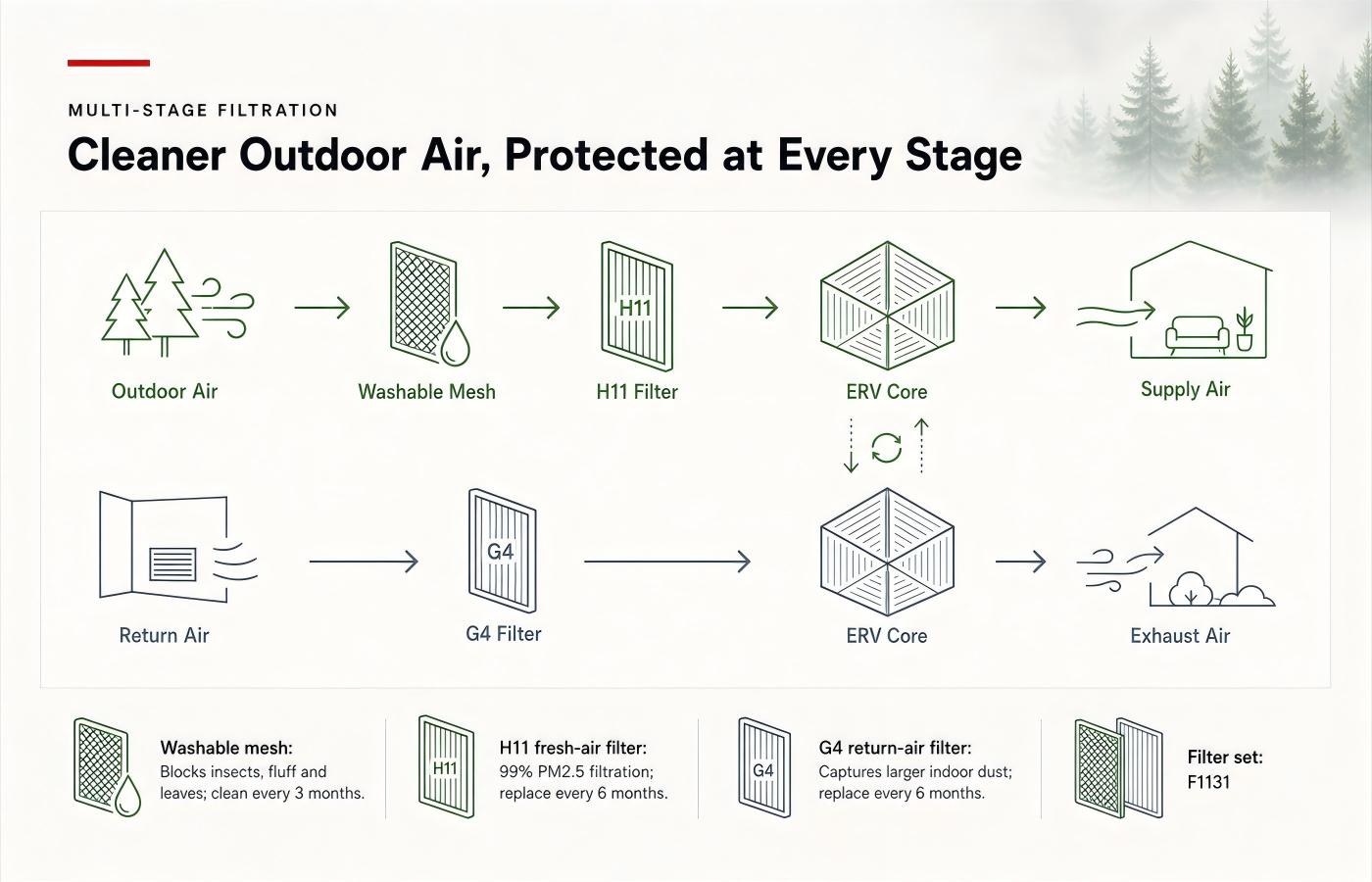
The S5 filters both air paths, and it filters them differently. Each side gets the media it actually needs.

• Fresh air side, H11 filter: removes 99% of PM2.5. High dust-holding capacity, low airflow resistance. Replace every 6 months.

• Return air side, G4 coarse filter: catches the larger dust the house itself produces. Replace every 6 months.

• Washable mesh screen: stops insects, pollen fluff, and leaves before they reach the filters. Rinse it every 3 months.

The filter set is model F1131.


A Non-Porous Membrane, and What That Buys You

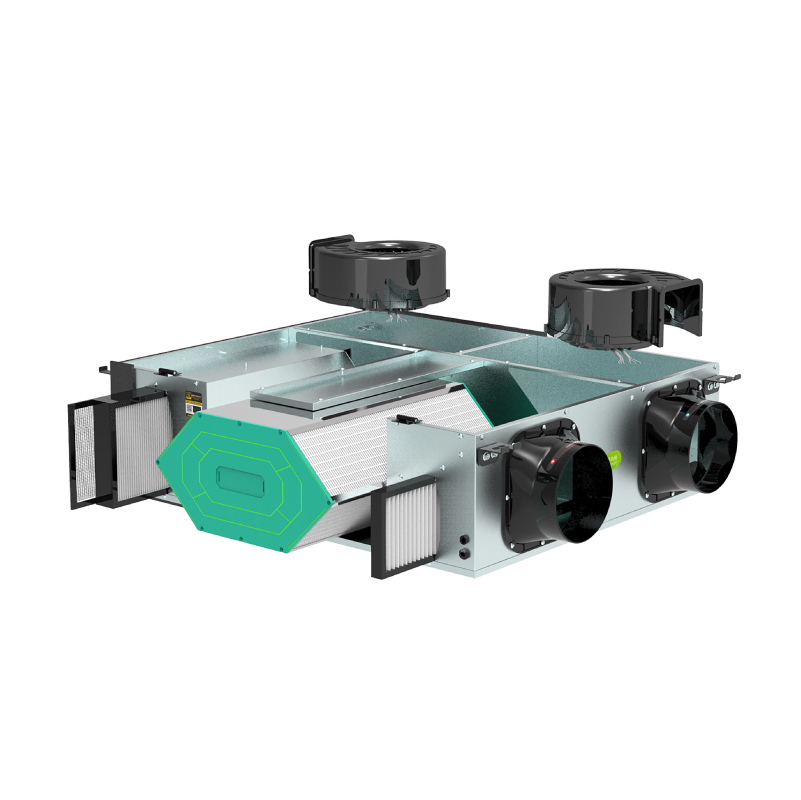
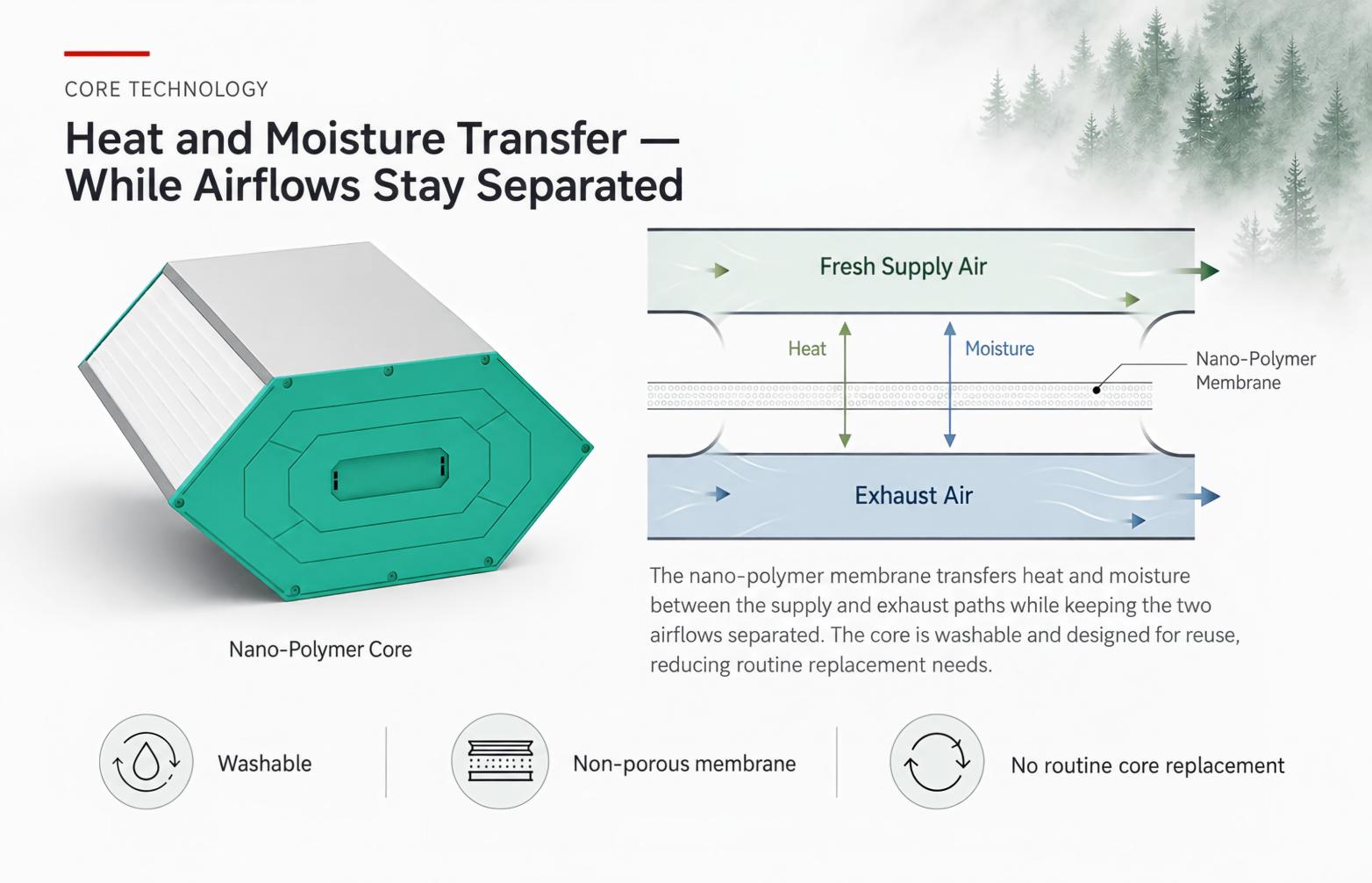
The core comes from DAIS in the United States. It is a ConsERV™ nano-polymer antibacterial membrane. Paper cores move moisture through porous media, so a little air always crosses with it. This core has no pores. Heat and moisture pass through the polymer itself. Air stays on its own side.

The numbers show it. Net fresh air volume is 343 m³/h out of 350 m³/h delivered, so the net fresh air ratio reaches 97.8%. MENRED cites virus particles at 70 to 200 nm and bacteria at 300 to 2,000 nm, and states that a non-porous membrane leaves them no pathway between the two streams.

The core is washable. It never needs replacing. Rinse it, dry it, refit it.


350 m³/h Rated, 400 m³/h Maximum

Rated airflow is 350 m³/h. Push the S5 and it reaches 400 m³/h. Rated power is 165 W, and specific fan power works out at 0.47 W/(m³/h).

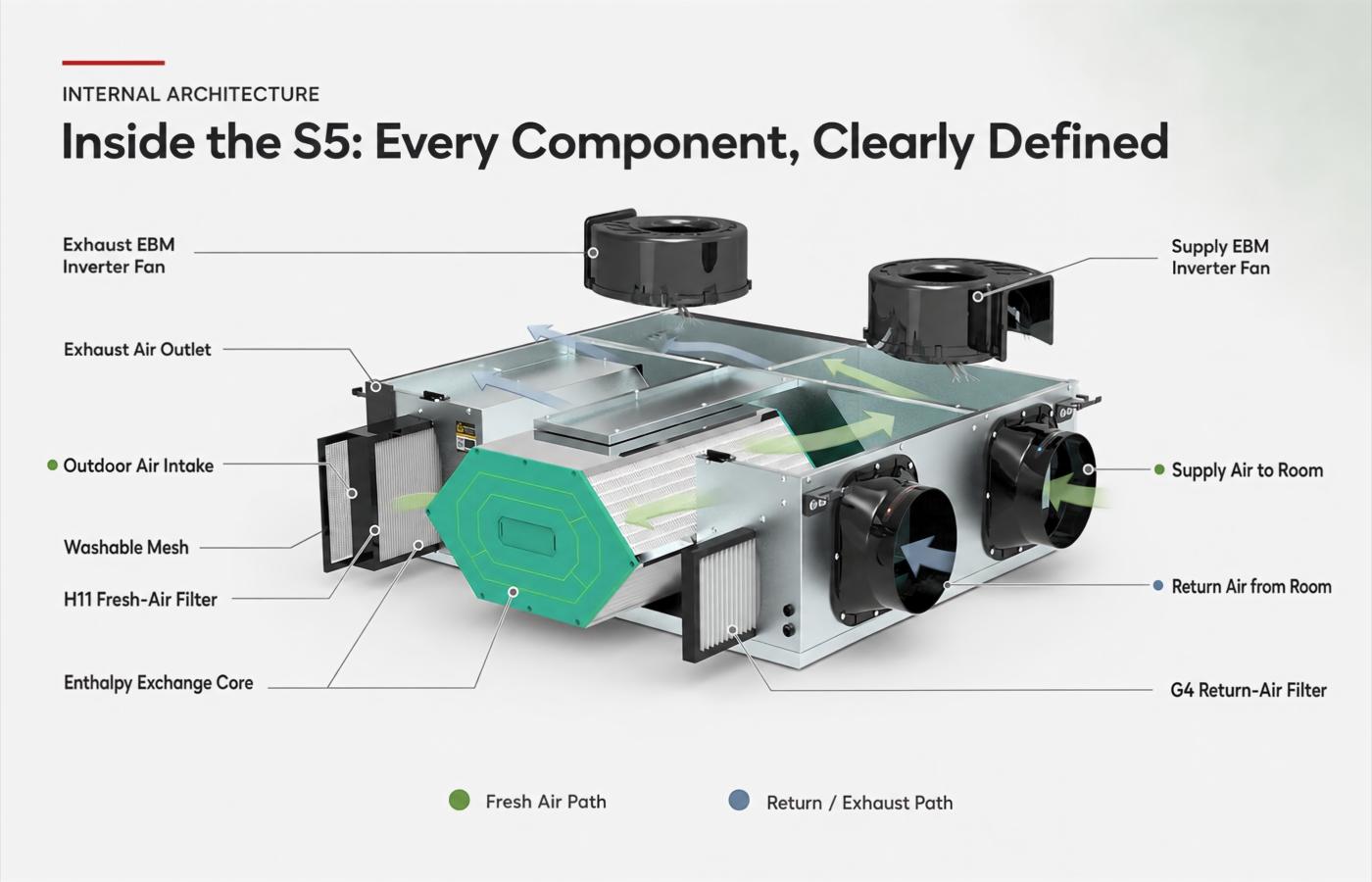
Two EBM inverter fans do the work, one on supply and one on exhaust, each driven on its own. Three speeds draw 79 W, 36 W, and 19 W. Leave the unit on low overnight and it costs almost nothing to run.

External static pressure is 80 Pa on supply and 50 Pa on exhaust. Both are adjustable from the controller, so a long duct run or an extra bend does not force a redesign.


2,218 W of Recovered Cooling Energy

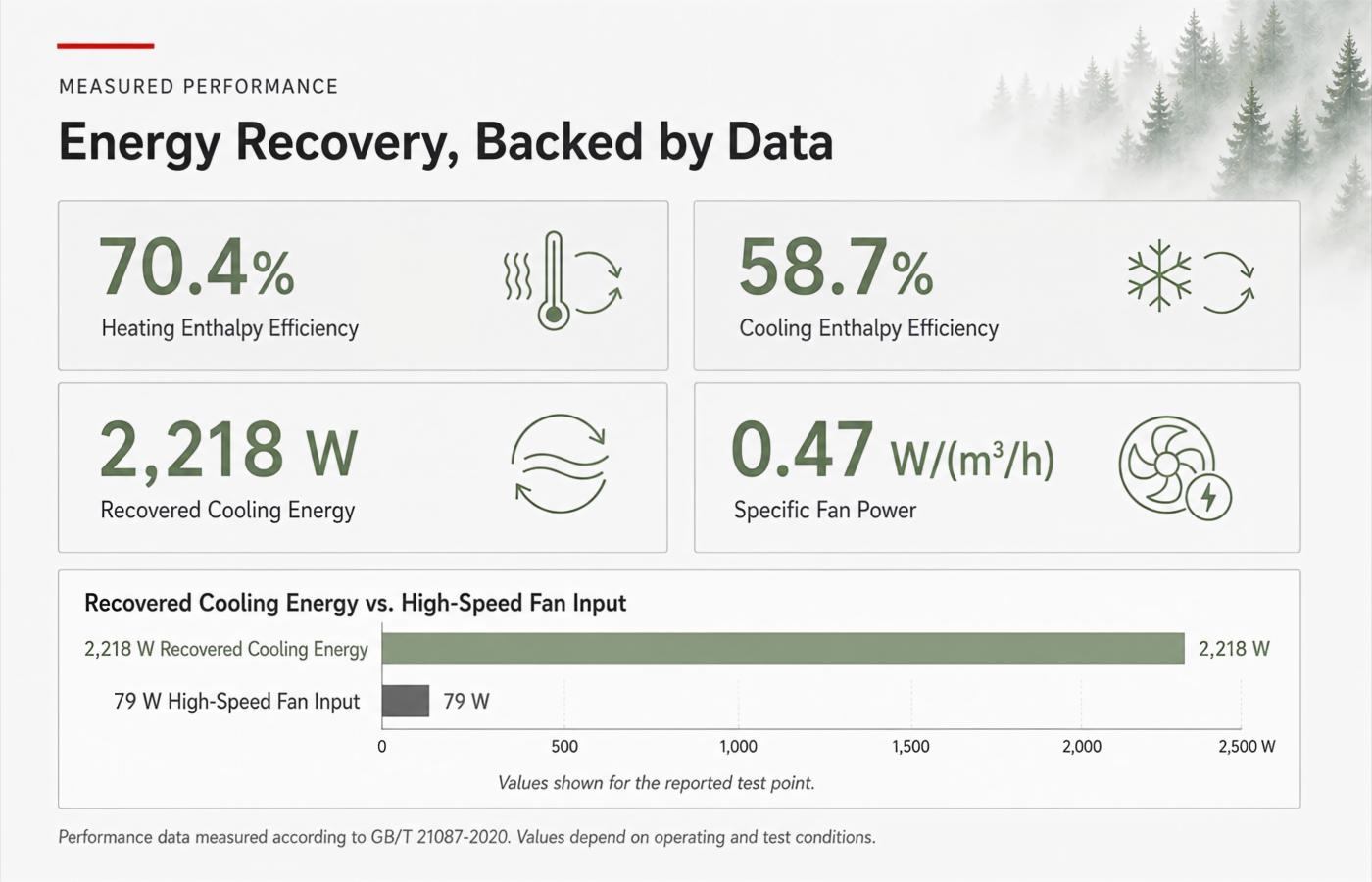
Verified to GB/T 21087-2020, the S5 recovers up to 2,218 W of cooling energy on the fresh-air side. It draws 79 W at high speed to do it. That gap is the whole point of an energy recovery ventilator.

Enthalpy exchange efficiency, measured to the same standard, is 70.4% in heating and 58.7% in cooling. Enthalpy covers heat and moisture together, not heat alone.


Slim 230 mm Body, 30 kg

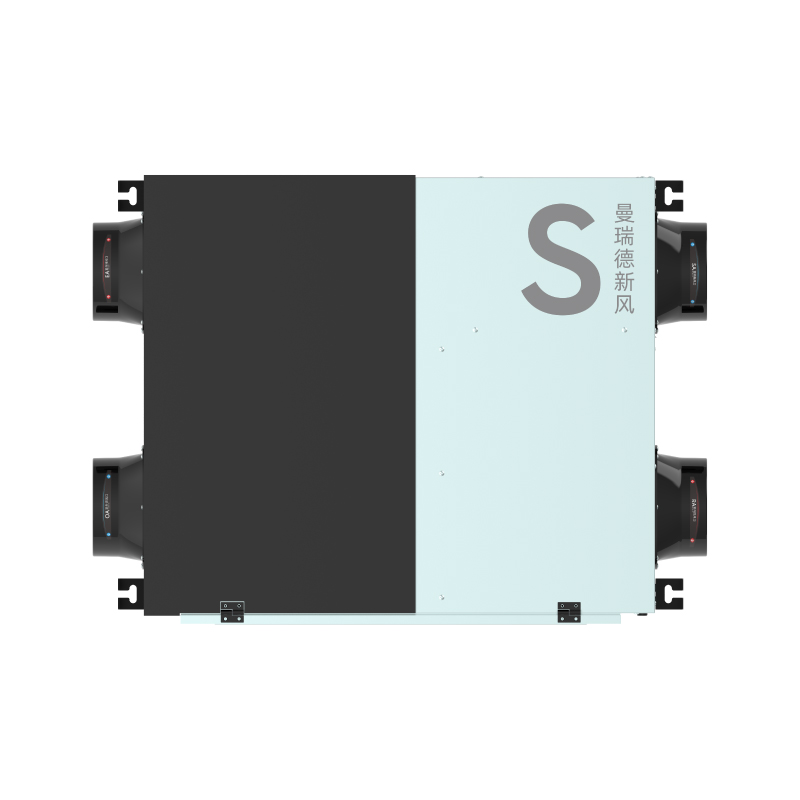
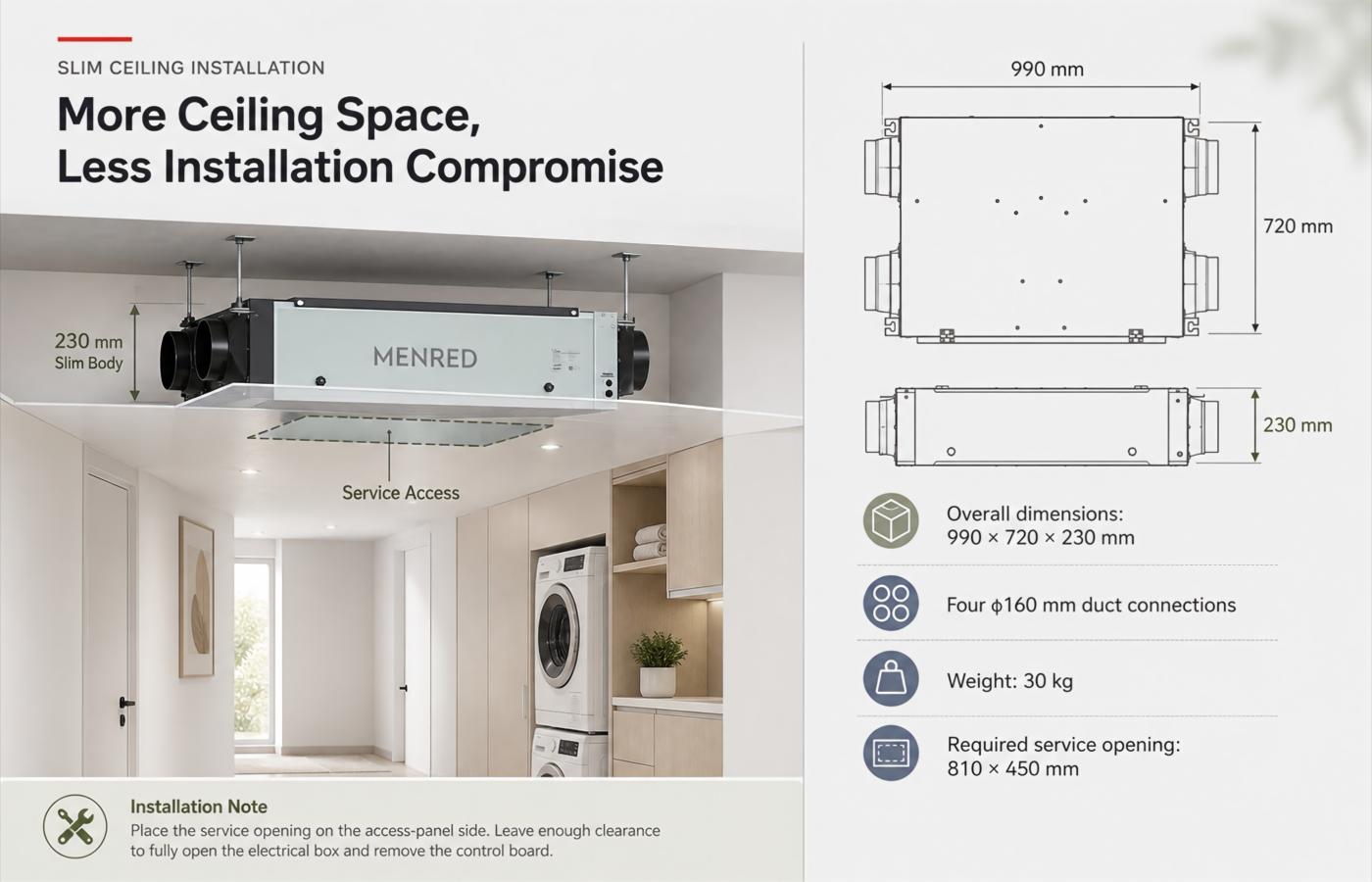
The S5 is 230 mm deep and weighs 30 kg. Overall size is 990 × 720 × 230 mm. It hides above a suspended ceiling in a corridor, a laundry, or a bathroom void. Duct connections are φ160 mm, four in total: outdoor intake, indoor supply, indoor return, outdoor exhaust.


Core Technologies & Benefits

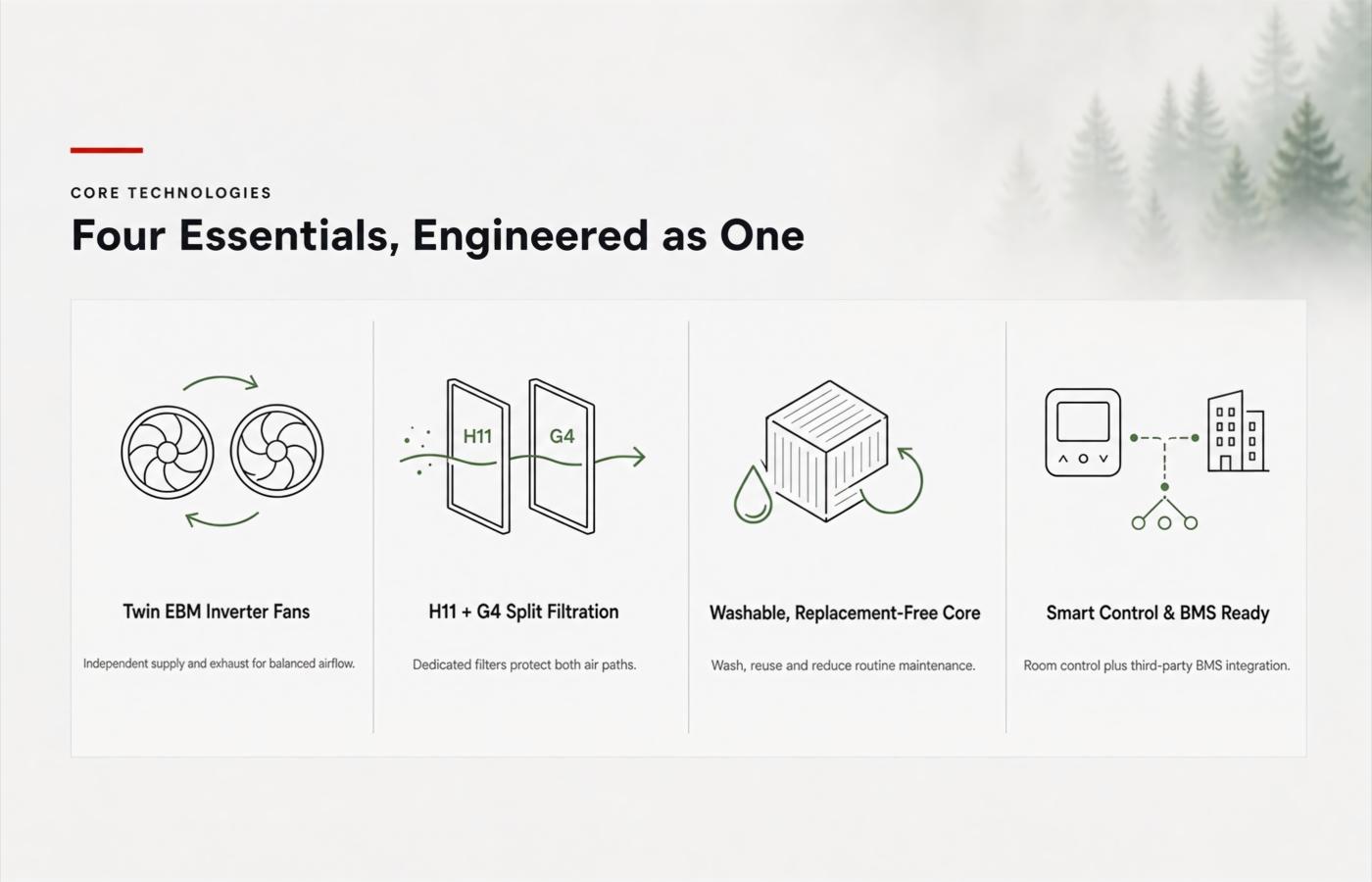
Six choices define how the S5 behaves once it is in the ceiling.

• DAIS ConsERV™ Membrane Core: nano-polymer, non-porous, antibacterial. Transfers heat and moisture without letting the two air streams meet.

• Washable, Replacement-Free Core: no paper element to buy again. Wash it and put it back.

• Twin EBM Inverter Fans: supply and exhaust run independently, so airflow balance holds across the whole speed range.

• Split Filtration Design: H11 on fresh air, G4 on return. 99% PM2.5 removal where it matters.

• Adjustable External Static Pressure: 80 Pa supply and 50 Pa exhaust, trimmable from the controller to match the duct design.

• Front-Access Service Panel: filters, core, fans, and control board all reach through a single 810 × 450 mm opening.


Smart Control and Third-Party Integration

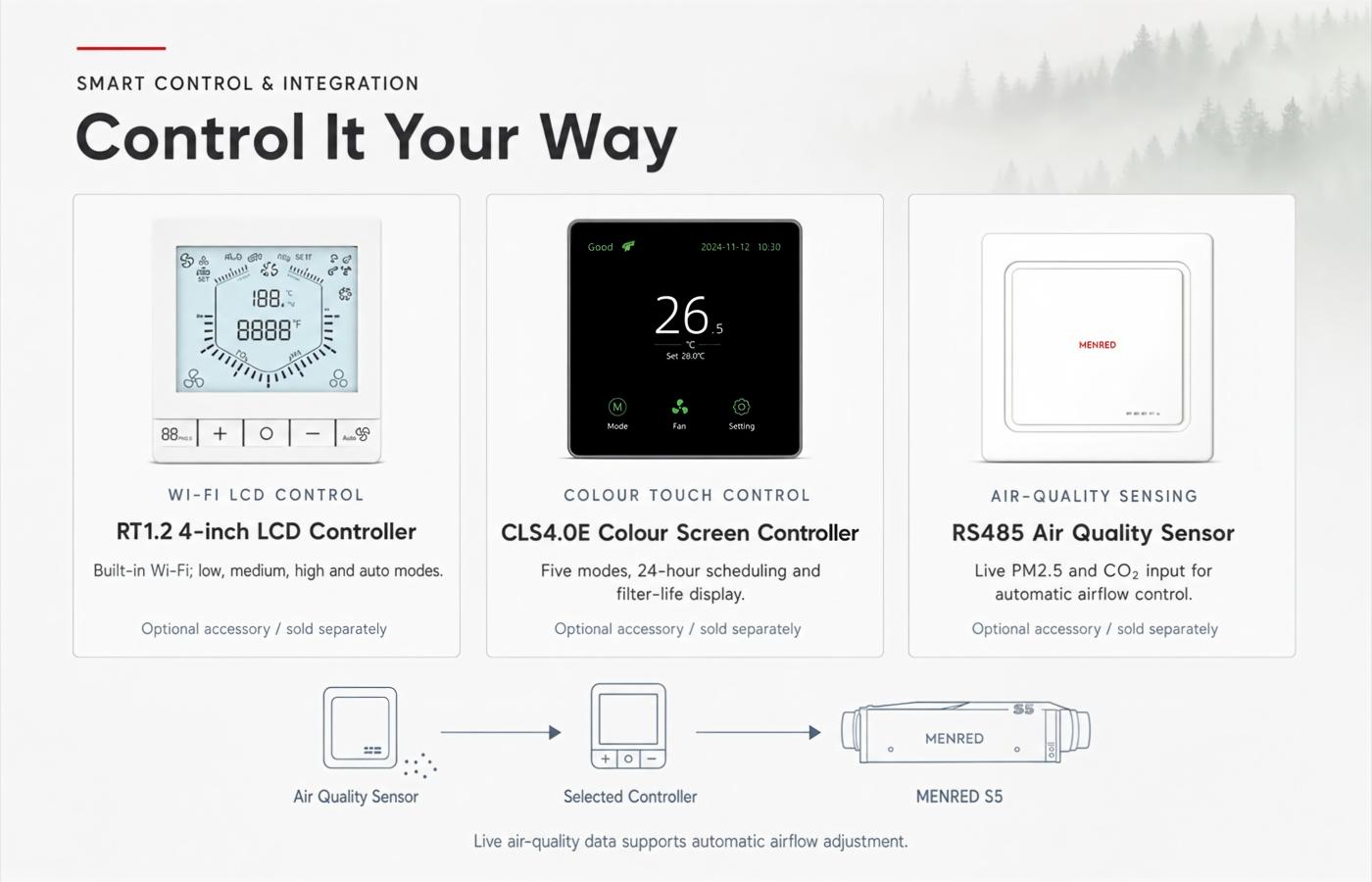
Three control accessories are available. All are sold separately.

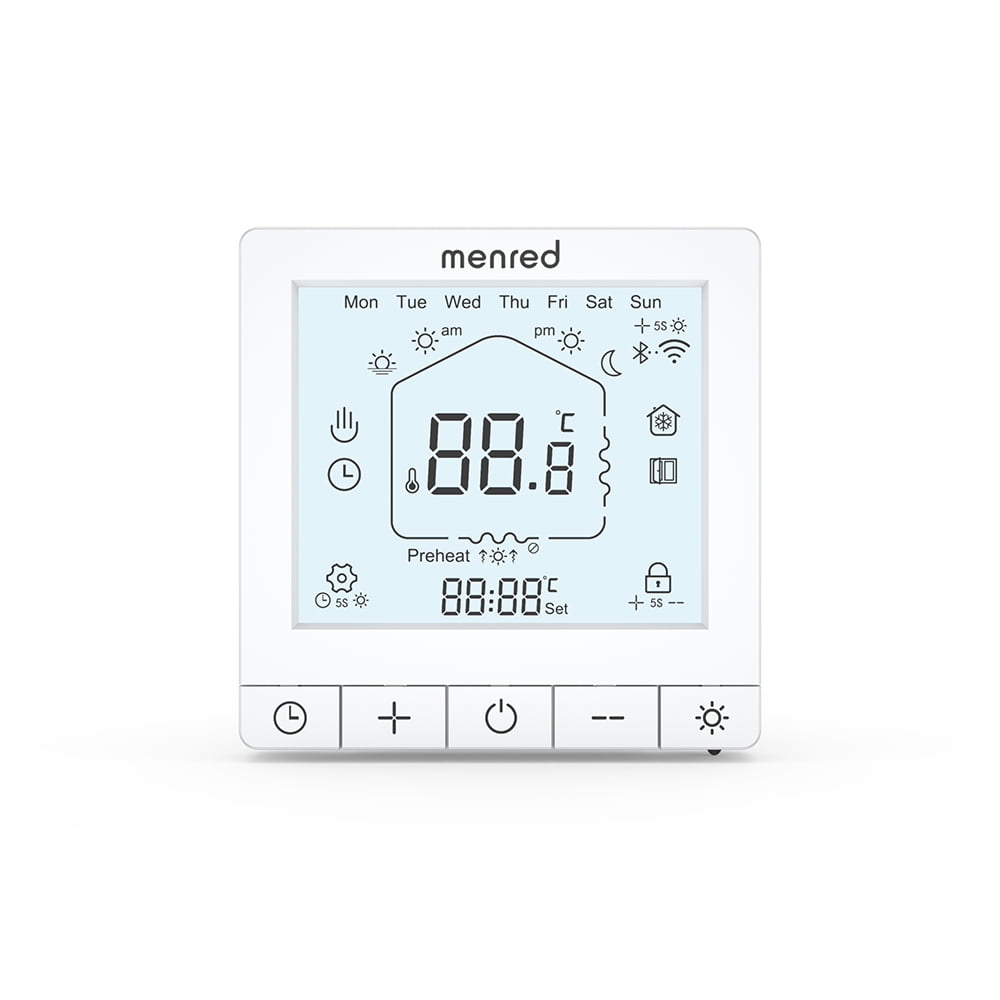
RT1.2 is a 4-inch LCD controller. It fits a standard 86 mm back box, draws under 1.5 W, and carries built-in Wi-Fi. Fan speeds are low, medium, high, and auto. Auto mode needs the optional RS485 air-quality sensor. Connect one and the controller adjusts fan speed to live PM2.5 and CO₂ readings. Protection rating is IP20 and the ambient range is -10 °C to 55 °C.

CLS4.0E is a colour screen controller with five modes, three fan speeds, 24-hour scheduling, and on-screen filter life tracking.

RS485 air quality sensor feeds live PM2.5 and CO₂ readings to whichever controller you fit.

The terminal block includes a passive linkage contact. That lets a third-party BMS or home automation system start and stop the S5 without extra hardware.


Installation and Maintenance

Hang the S5 from threaded rods inside a removable suspended ceiling. Leave an 810 × 450 mm service opening on the door-panel side. Check two things before you close the ceiling: the electrical box must open fully, and the control board must come out. Wiring is fixed, so the circuit needs an all-pole switch with at least 3 mm contact separation, plus reliable earthing.

Upkeep takes minutes. Rinse the mesh every 3 months. Swap the G4 and the H11 every 6 months. Wash the core when it looks dirty and put it straight back. One full inspection every six months keeps the airflow where the design intended.


Technical Specifications

Model
S5
Power Supply
AC 220V ~ 50Hz
Rated Air Volume
350 m³/h
Max Air Volume
400 m³/h
Rated Power
165 W
Max Power
220 W
Fan Speed Power Draw
79 W high / 36 W medium / 19 W low
Specific Fan Power
0.47 W/(m³/h)
External Static Pressure
80 Pa supply / 50 Pa exhaust, adjustable via controller
Enthalpy Exchange Efficiency (Heating)
70.4%
Enthalpy Exchange Efficiency (Cooling)
58.7%
Recovered Cooling Energy, Fresh-Air Side
2,218 W
Net Fresh Air Volume
343 m³/h
Net Fresh Air Ratio
97.8%
PM2.5 Filtration Efficiency
99%
Filter Model
F1131 (washable mesh + G4 coarse + H11), 6-month replacement cycle
Noise Level
39.5 dB(A)
Dimensions (A × B × C)
990 × 720 × 230 mm
Duct Connection Diameter
φ160 mm
Weight
30 kg

Data download

FAQs

How does an ERV fit into the MENRED Wuheng Climate System? How does an ERV fit into the MENRED Wuheng Climate System?
The MENRED Wuheng Climate System takes an integrated approach to indoor climate by coordinating temperature control, humidity management, fresh air, cleanliness, and quietness.
Read More
Can an ERV work with radiant heating and cooling? Can an ERV work with radiant heating and cooling?
Yes. An ERV can work alongside radiant heating and cooling as part of an integrated indoor climate system.
Read More
How often should an ERV be serviced? How often should an ERV be serviced?
Routine maintenance generally includes checking filters, inspecting the heat or enthalpy exchange core, checking fans and accessible air passages, and verifying that supply and exhaust airflow remain appropriate.
Read More
How often should ERV filters be replaced? How often should ERV filters be replaced?
Filter maintenance intervals depend on the filter type, outdoor air quality, operating hours, and the manufacturer's instructions.
Read More
Can an ERV be installed in an existing home? Can an ERV be installed in an existing home?
Yes. Depending on the building layout and the selected model, an ERV may be suitable for retrofit projects as well as new construction.
Read More
Is an ERV noisy? Is an ERV noisy?
ERVs contain fans and moving air, so some operating noise is unavoidable. The perceived noise depends on fan speed, unit design, installation quality, duct sizing, airflow velocity, vibration isolation, and the location of the unit.
Read More
Where should an ERV be installed? Where should an ERV be installed?
The installation location depends on the ERV model, building layout, duct routing, outdoor air intake and exhaust locations, and access requirements.
Read More
How do I choose the right ERV for my home? How do I choose the right ERV for my home?
Start with the required ventilation airflow, then evaluate the unit's delivered airflow at the planned external static pressure, recovery performance, filtration, sound levels, dimensions, power consumption, controls, and maintenance access.
Read More
Does an ERV provide clean air without opening windows? Does an ERV provide clean air without opening windows?
An ERV can provide a controlled supply of outdoor air while reducing the need to open windows solely for ventilation.
Read More
Can an ERV remove PM2.5, dust, and pollen? Can an ERV remove PM2.5, dust, and pollen?
An ERV can reduce incoming airborne particles when equipped with suitable filters. Its effectiveness depends on the filter's tested efficiency, the particle size, sealing, airflow, and filter maintenance.
Read More
Can an ERV reduce indoor CO₂ levels? Can an ERV reduce indoor CO₂ levels?
An ERV can help reduce indoor carbon dioxide (CO₂) concentrations by replacing CO₂-rich indoor air with outdoor air, provided that the outdoor airflow and air distribution are adequate for the occupancy.
Read More
How much fresh air does a home need? How much fresh air does a home need?
Required outdoor airflow depends on the applicable building code, occupancy, floor area, room use, and the ventilation design standard used for the project.
Read More
Is an ERV suitable for hot and humid climates? Is an ERV suitable for hot and humid climates?
An ERV can be part of a ventilation strategy for hot and humid climates, but the design must account for both heat and moisture loads.
Read More
Does an ERV work in both summer and winter? Does an ERV work in both summer and winter?
Yes. An appropriately designed ERV can operate in both heating and cooling seasons.
Read More
Can an ERV control indoor humidity? Can an ERV control indoor humidity?
An ERV with an enthalpy exchange core can transfer moisture between incoming and outgoing air streams. This may help moderate indoor humidity, but it does not actively remove moisture in the same way as a dedicated dehumidifier.
Read More
Does an ERV save energy? Does an ERV save energy?
An ERV can reduce the energy required to condition outdoor ventilation air by recovering part of the heat and, where applicable, moisture from the exhaust air.
Read More
What is the difference between an ERV and a standard exhaust fan? What is the difference between an ERV and a standard exhaust fan?
A standard exhaust fan removes indoor air but does not normally recover energy from it. Replacement outdoor air must enter through designed inlets or other openings, and its temperature and moisture can add to the building's heating or cooling load.
Read More
What is the difference between an ERV and an HRV? What is the difference between an ERV and an HRV?
An HRV (Heat Recovery Ventilator) primarily transfers sensible heat between incoming and outgoing air. An ERV (Energy Recovery Ventilator) can transfer sensible heat and moisture when equipped with an enthalpy exchange core.
Read More
How does an ERV system work How does an ERV system work
An ERV draws outdoor air into the building and exhausts stale indoor air through separate air passages. Inside the energy recovery core, heat and moisture can transfer between the two air streams without intentionally mixing the bulk air streams.
Read More
What is an Energy Recovery Ventilator (ERV)? What is an Energy Recovery Ventilator (ERV)?
An Energy Recovery Ventilator (ERV) is a mechanical ventilation system that supplies outdoor air and exhausts stale indoor air while transferring heat and, in enthalpy recovery systems, moisture between the two air streams.
Read More
What is the difference between an ERV and a dehumidifier? What is the difference between an ERV and a dehumidifier?
An ERV primarily provides controlled ventilation and energy recovery. A dehumidifier primarily removes moisture from indoor air.
Read More
Can an ERV control indoor humidity? Can an ERV control indoor humidity?
An ERV can transfer moisture between incoming and outgoing air depending on its core technology and operating conditions.
Read More
Why Does Our Home Need an ERV Ventilation System? Why Does Our Home Need an ERV Ventilation System?
Fresh air is not just about breathing better. It is an essential part of creating a comfortable, healthy, and durable home.
Read More
Contact

MENRED Group

Economy Park HQs, Yueqing City, China.

MENRED GmbH

Weisswasser Germany

MENRED Green Building Industrial Park

Lingkun Island,Wenzhou City,Zhejiang China.

MENRED Enviro-Tech Industrial Park

Nanhu District, Jiaxing City, Zhejiang China.